

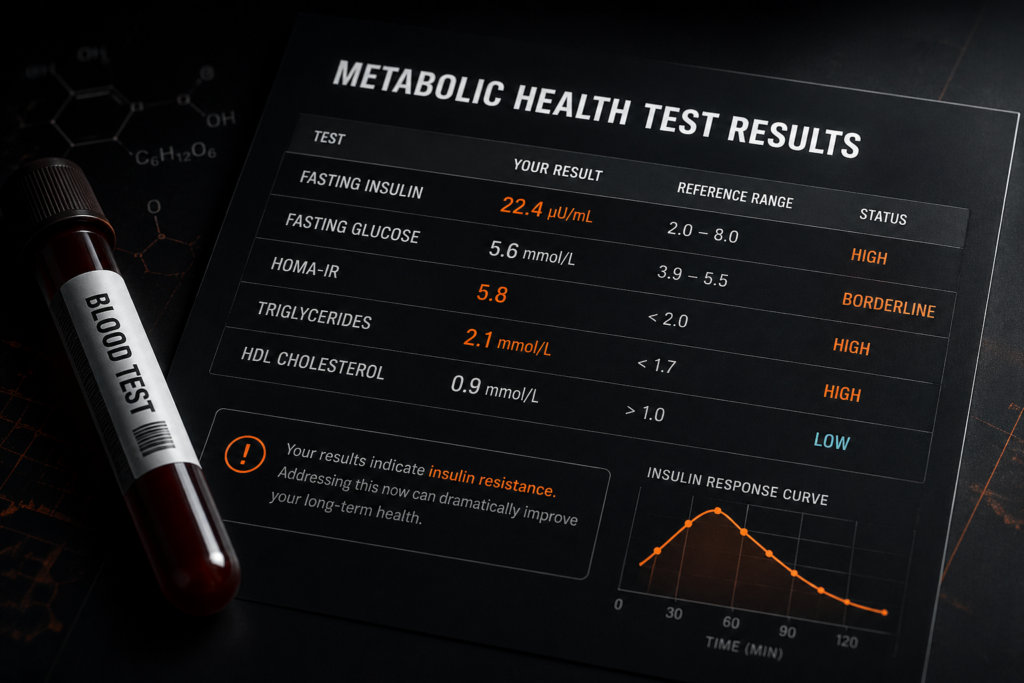
If you have been to your GP with fatigue, weight gain, or brain fog and been told your bloods are normal, there is a reasonable chance insulin resistance was missed. Learn how to tell if you have insulin resistance:
Not because your GP was wrong to run the tests they ran. But the standard blood panel does not include the markers that catch insulin resistance early. By the time the numbers your GP looks at are flagged, the condition has often been established for years.
This post covers the specific tests that reveal insulin resistance, what the numbers mean, and how to get them.
If you are still unsure whether insulin resistance applies to you, start with the symptoms guide first.
For the full picture, read: What Is Insulin Resistance and How Do You Fix It?
Why Standard Blood Tests Miss It?
The test your GP is most likely to run is a fasting glucose test. It measures the amount of glucose in your blood after an overnight fast. If the result is below 5.5 mmol/L, you will typically be told everything is fine.
The problem is that fasting glucose is a late-stage indicator. In the early stages of insulin resistance, the pancreas compensates by producing more insulin to keep glucose levels in range. Blood glucose appears normal. The test passes. But the underlying dysfunction – chronically elevated insulin, progressively less responsive cells – is worsening with every meal.
A normal fasting glucose result does not rule out insulin resistance. It simply means the pancreas is still compensating.
The Tests That Actually Reveal Insulin Resistance
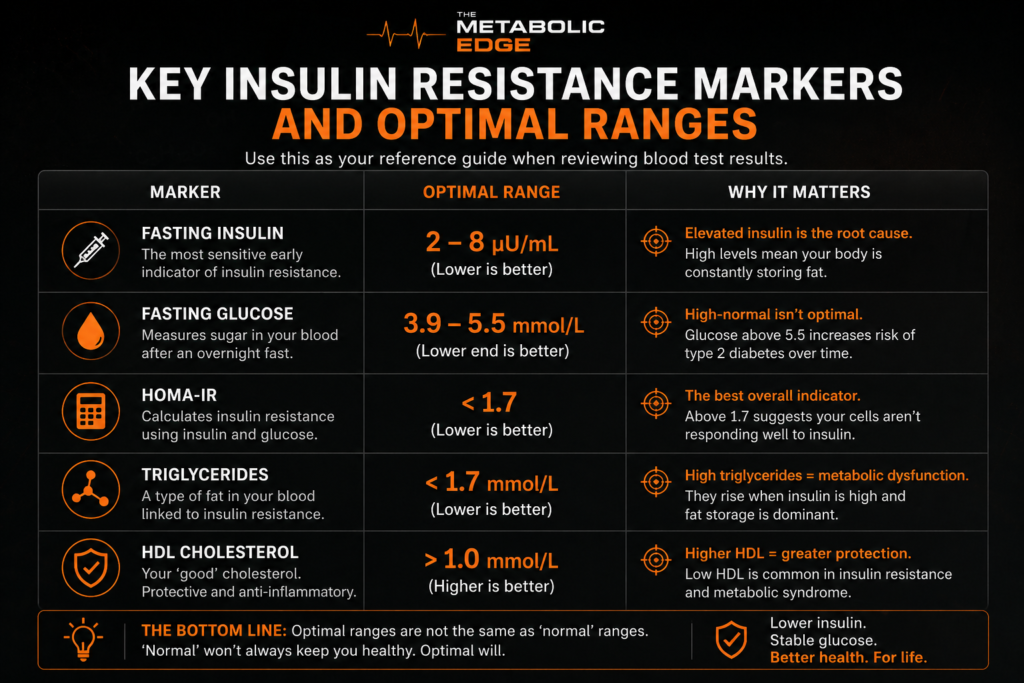
1. Fasting Insulin
This is the single most important test for early detection. It is rarely requested on a standard blood panel.
Fasting insulin measures how much insulin your pancreas is producing after an overnight fast. In a healthy metabolic system, fasting insulin should be low – the body requires minimal insulin to maintain stable blood sugar at rest.
What the numbers mean:
- Below 5 mU/L: optimal
- 5-10 mU/L: acceptable, worth monitoring
- Above 10 mU/L: strong indicator of insulin resistance, even if glucose appears normal
- Above 15 mU/L: significant insulin resistance likely
To get this test, you will need to request it specifically. Most GPs will not order it unless asked. You can also access it privately through services such as Medichecks or Thriva for around £30-£40 (as of April 2026).
2. HOMA-IR
HOMA-IR (Homeostatic Model Assessment of Insulin Resistance) is a calculation derived from your fasting glucose and fasting insulin results. It gives a single score which indicates how insulin-resistant you are.
The formula: Fasting insulin (mU/L) x Fasting glucose (mmol/L) divided by 22.5
What the score means:
- Below 1.0: excellent insulin sensitivity
- 1.0-2.0: normal range
- Above 2.0: developing insulin resistance
- Above 2.9: significant insulin resistance
If your GP has ordered both fasting glucose and fasting insulin, you can calculate your HOMA-IR score yourself using the formula above. There are also free calculators available online.
3. Triglyceride-to-HDL Ratio
This is one of the most powerful indirect markers of insulin resistance available on a standard lipid panel – and most people never have it calculated for them.
The triglyceride-to-HDL ratio reflects two things that insulin resistance consistently disrupts: it raises triglycerides and lowers HDL cholesterol. A high ratio is a reliable proxy for elevated insulin even when fasting glucose looks normal.
How to calculate it: Divide your triglyceride result by your HDL result (both in mmol/L).
What the ratio means:
- Below 1.0: excellent
- 1.0-2.0: acceptable
- Above 2.0: strong indicator of insulin resistance
- Above 3.0: significant metabolic dysfunction likely
If you have had a recent lipid panel, you can calculate this now from your existing results.
4. HbA1c
HbA1c measures your average blood glucose over the preceding two to three months. It is more useful than a single fasting glucose reading because it smooths out day-to-day variation.
What the numbers mean:
- Below 39 mmol/mol (5.7%): normal
- 39-47 mmol/mol (5.7-6.4%): pre-diabetes range – intervention is urgent
- Above 48 mmol/mol (6.5%): type 2 diabetes threshold
HbA1c is a later-stage marker. By the time it is elevated, insulin resistance has been present for some time. It is useful for tracking progression but should not be the only test relied upon for early detection.
5. Waist Circumference
This is not a blood test, but it is one of the most reliable and accessible indicators of insulin resistance available.
Visceral fat – the fat stored around the abdominal organs – is both a symptom and a driver of insulin resistance. Waist circumference is a direct measure of visceral fat accumulation.
The thresholds:
- Men: above 94cm (37 inches) indicates elevated risk
- Women: above 80cm (31.5 inches) indicates elevated risk
Measure at the midpoint between the bottom of the ribcage and the top of the hip bone, after a normal exhale. If you are above these thresholds and recognise other symptoms, the case for testing strengthens considerably.
How to Read Your Results Together
No single marker tells the full story. The picture becomes clearer when multiple indicators are read together.
A useful framework:
- Fasting insulin above 10 + HOMA-IR above 2.0: strong case for insulin resistance regardless of glucose
- Normal fasting glucose + elevated triglyceride: HDL ratio: early insulin resistance is likely
- HbA1c in the pre-diabetes range + elevated waist circumference: intervention is urgent
If two or more markers are outside the optimal range, treat it as a meaningful signal rather than waiting for a formal diagnosis.
How to Tell if You Have Insulin Resistance
How to Request These Tests
For fasting insulin and HOMA-IR, the most direct route is to ask your GP specifically. Frame it as a request to investigate insulin resistance rather than diabetes – some GPs are more receptive to this framing. If the request is declined, private testing is straightforward and affordable.
Reliable private testing options in the UK:
- Medichecks – insulin resistance specific panels available
- Thriva – home finger-prick testing with GP-reviewed results
- Forth – metabolic health panels
A full insulin resistance panel, including fasting insulin, glucose, HbA1c, and lipids, typically costs £40-£70 privately (as of April 2026).
What to Do With the Results
If your results suggest insulin resistance, the next step is not medication – it is dietary and lifestyle intervention. The evidence for reversing insulin resistance through a low-carbohydrate approach combined with intermittent fasting is substantial and well-established.
A practical starting point is the Free 3-Day Metabolic Reset – a structured 72-hour protocol that begins lowering insulin, stabilising blood sugar, and breaking the cravings cycle within days.
The full reversal protocol is covered here: What Is Insulin Resistance and How Do You Fix It?