
Most people with insulin resistance have never been told they have it.
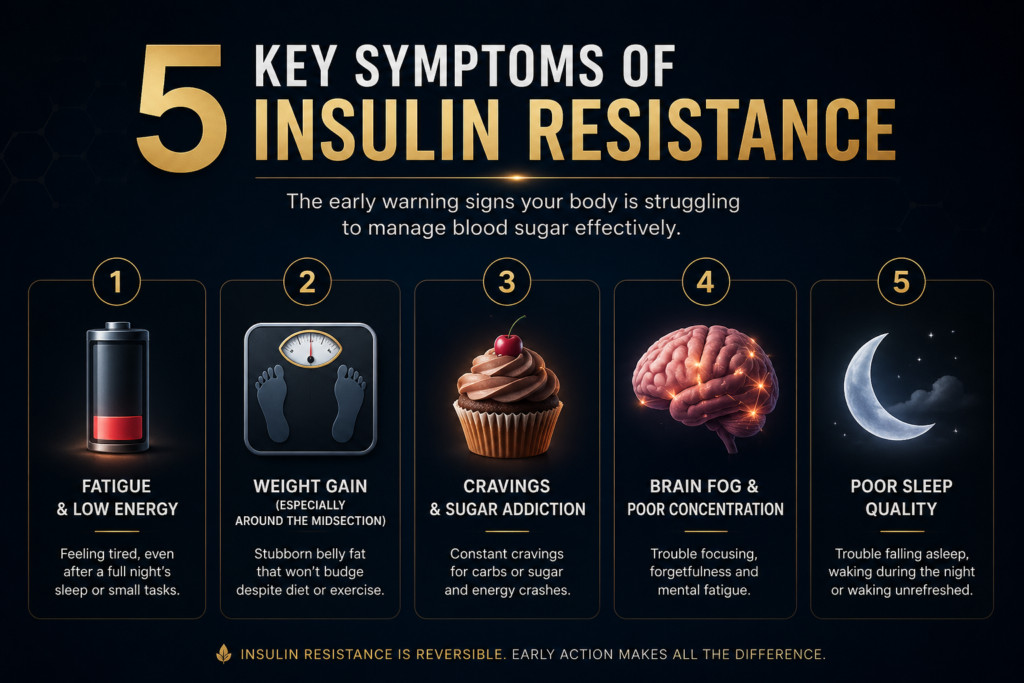
Not because it is rare – it affects an estimated one in three adults in the UK. But because insulin resistance symptoms are easy to dismiss. They look stressed. They look like they are ageing. They look like they’re not sleeping well enough.
This post covers the five most common symptoms of insulin resistance, why they happen, and what to do if you recognise them in yourself.
If you want the full picture first, read the complete guide: What Is Insulin Resistance and How Do You Fix It?
Why Insulin Resistance Is So Easy to Miss?
Insulin resistance does not arrive with a dramatic warning. It builds slowly, over months and years, driven by diet, inactivity, poor sleep, and chronic stress.
By the time most people notice something is wrong, the condition has been developing quietly in the background for a long time. Standard blood tests rarely catch it early. Fasting glucose can appear completely normal while insulin resistance is already well established.
This is why recognising the symptoms matters. They are often the earliest signal available.
The 5 Most Common Symptoms of Insulin Resistance
1. Energy Crashes After Meals
If you regularly feel tired, heavy, or mentally foggy within an hour of eating – particularly after carbohydrate-heavy meals – this is one of the clearest early signals of impaired insulin function.
In a healthy metabolic system, food provides a steady release of energy. In insulin resistance, the glucose from a meal floods the bloodstream faster than cells can absorb it. Insulin spikes sharply. Blood sugar then drops. The result is the familiar post-meal slump that many people assume is normal.
It is not normal. It is a metabolic signal.
2. Persistent Fatigue That Sleep Does Not Fix
This is one of the most consistent complaints from people who later discover they have insulin resistance. The fatigue is not resolved by a full night of sleep. It is present on waking. It deepens through the day.
The mechanism is straightforward: when cells are resistant to insulin, they cannot efficiently utilise glucose for fuel. The body is receiving calories, but the cells are not getting the energy. The result is a persistent, low-grade exhaustion that has nothing to do with how much you slept and everything to do with how well your metabolism is functioning.
3. Strong Cravings for Sugar and Refined Carbohydrates
Intense cravings – particularly the mid-afternoon pull toward something sweet or starchy – are not a willpower problem. They are a hormonal signal.
When blood sugar drops sharply after an insulin spike, the brain triggers a craving for fast-acting glucose to bring levels back up. This sets up a cycle: cravings lead to carbohydrate consumption, which causes another insulin spike, which causes another drop, which triggers more cravings.
If you find yourself regularly reaching for sugar or refined carbohydrates in the afternoon, your body may be stuck in this cycle.
4. Belly Fat That Resists Conventional Dieting
Visceral fat – the fat stored around the abdominal organs rather than under the skin – is both a symptom and a driver of insulin resistance. It is the specific type of fat accumulation associated with chronically elevated insulin.
This is why calorie restriction alone so often fails people with insulin resistance. Reducing calories does not address the insulin dysregulation that is directing the body to store fat rather than burn it. Until insulin levels are brought down, the body’s fat-storage signals remain dominant.
Belly fat that persists despite eating less is a significant indicator that insulin, not calories, is the primary problem.
5. Brain Fog and Difficulty Concentrating
The brain accounts for roughly 20% of the body’s energy consumption. When insulin resistance impairs glucose delivery at the cellular level, the brain is among the first organs affected.
The result is the kind of thinking that feels like wading through fog: difficulty concentrating, slow word retrieval, reduced mental sharpness. Many people notice this is worse after eating – particularly after high-carbohydrate meals – which points directly to the post-meal insulin spike as the trigger.
Symptoms Specific to Women
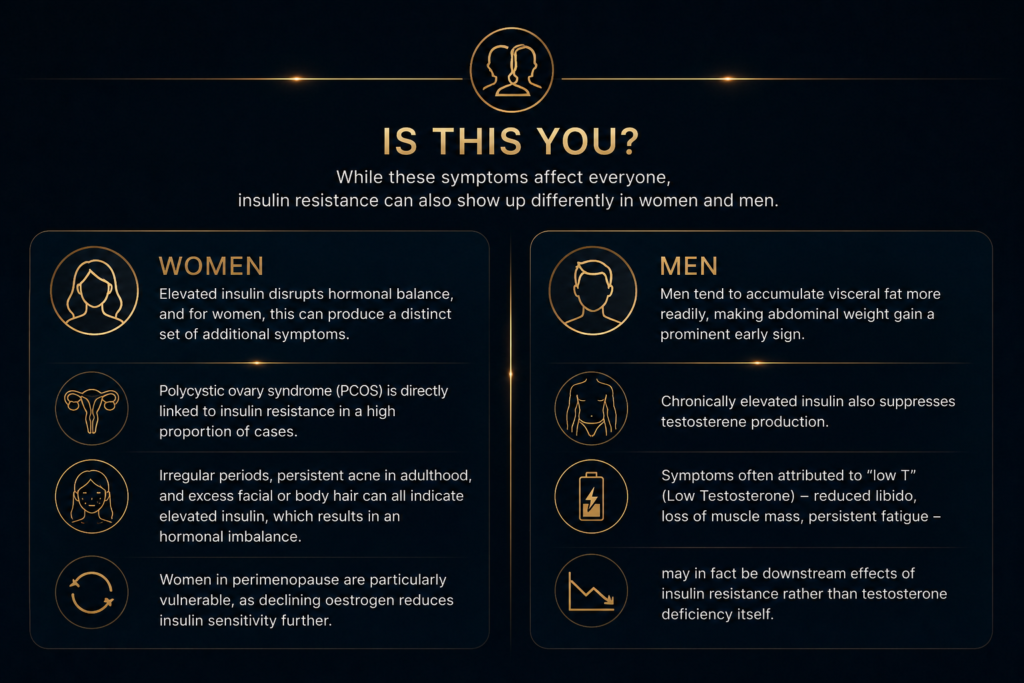
Elevated insulin disrupts hormonal balance, and for women, this can produce a distinct set of additional symptoms.
Polycystic ovary syndrome (PCOS) is directly linked to insulin resistance in a high proportion of cases. Irregular periods, persistent acne in adulthood, and excess facial or body hair can all indicate elevated insulin, resulting in an hormonal imbalance. Women in perimenopause are particularly vulnerable, as declining oestrogen reduces insulin sensitivity further.
Symptoms Specific to Men
Men tend to accumulate visceral fat more readily, making abdominal weight gain a prominent early sign. Chronically elevated insulin also suppresses testosterone production. Symptoms often attributed to “low T” (Low Testosterone) – reduced libido, loss of muscle mass, persistent fatigue – may in fact be downstream effects of insulin resistance rather than testosterone deficiency itself.
How Many of These Apply to You?
If three or more of the above symptoms are present simultaneously, insulin resistance is a likely underlying cause. The more symptoms that overlap, the stronger the signal.
The important point is that these are not inevitable. They are not a normal part of ageing. They are the result of a correctable metabolic dysfunction – and the evidence for reversing it through diet and lifestyle is substantial.
What to Do Next
The first step is knowing where you stand. The second is taking action before the condition progresses.
A useful starting point is Get Your FREE 3-Day Metabolic Reset – a structured 72-hour protocol designed to lower insulin, stabilise blood sugar, and break the cravings cycle. It is the entry point into a low-carbohydrate approach that addresses the root cause rather than the symptoms.
The full reversal protocol is covered here: What Is Insulin Resistance and How Do You Fix It?
Author: Martin Elwood, Level 5 Diploma in Diet and Nutrition